
Have you ever wondered how you can get stronger without stepping foot in a gym or lifting a single weight? Bodyweight workouts can be a game-changer, making it possible to build strength and muscle right in the comfort of your home. These routines utilize your body’s own weight as resistance, providing a practical and cost-effective way to enhance your fitness levels.

Understanding Bodyweight Workouts
Bodyweight workouts are exercises that do not require free weights or machines. Instead, these workouts use your body as the primary tool for resistance. They can be extraordinarily effective for building strength in all major muscle groups.
The Science Behind Bodyweight Training
Bodyweight workouts rely on principles of resistance and overload. When you lift and lower your own body weight, muscles have to exert a significant force, which can lead to muscle growth and increased strength over time. This type of training engages multiple muscle groups simultaneously, contributing to overall functional strength.
Advantages of Bodyweight Workouts
There are numerous benefits to incorporating bodyweight exercises into your routine:
- Convenience: No need for special equipment or a gym membership.
- Versatility: Suitable for various fitness levels, from beginner to advanced.
- Functionality: Develops strength that translates to everyday activities.
- Efficiency: Engages multiple muscle groups at once, often including core muscles for stability and balance.
- Customization: Easily adjustable difficulty by changing form or increasing repetitions.
Core Bodyweight Exercises
A well-rounded bodyweight workout routine must include exercises that target different muscle groups. Below are some foundational moves.
Push-Ups
Target Muscles: Chest, shoulders, triceps, and core
The push-up is a classic bodyweight move that can be modified for different levels of difficulty.
Instructions:
- Start in a plank position with your hands shoulder-width apart.
- Lower your body until your chest almost touches the ground.
- Push back up to the starting plank position.
Variations:
- Knee Push-Ups: Do the push-up from your knees for a less intense version.
- Diamond Push-Ups: Place your hands close together under your chest to target the triceps more.
Squats
Target Muscles: Quads, hamstrings, glutes, and core
Squats target the lower body and are crucial for developing leg and core strength.
Instructions:
- Stand with feet shoulder-width apart.
- Lower your hips back and down as if sitting in a chair.
- Ensure your knees don’t extend past your toes.
- Return to the standing position.
Variations:
- Jump Squats: Add a jump to the squat for a plyometric version.
- Pistol Squats: Perform the squat on one leg to increase difficulty.
Planks
Target Muscles: Core, shoulders, and lower back
Planks are essential for building core strength and stability.
Instructions:
- Start in a forearm plank position.
- Keep your body in a straight line from head to heels.
- Hold the position while engaging your core.
Variations:
- Side Planks: Rotate to one side, balancing on one forearm and the side of one foot.
- Plank with Arm Lift: Lift one arm straight ahead while maintaining balance.
Lunges
Target Muscles: Quads, hamstrings, glutes, and core
Lunges are great for working each leg independently and improving balance.
Instructions:
- Stand tall with feet together.
- Step forward with one foot and lower your hips until both knees are at 90-degree angles.
- Push back up to the starting position.
Variations:
- Reverse Lunges: Step backward instead of forward.
- Walking Lunges: Move forward with each lunge step.
Pull-Ups
Target Muscles: Back, shoulders, and biceps
Pull-ups are one of the most effective bodyweight exercises for upper body strength.
Instructions:
- Grip a pull-up bar with palms facing away from you.
- Pull your body up until your chin is above the bar.
- Lower yourself back to the starting position.
Variations:
- Chin-Ups: Palms facing you, which places more emphasis on the biceps.
- Assisted Pull-Ups: Use a resistance band for extra support.

Structuring Your Workout
To maximize the benefits of bodyweight exercises, it’s crucial to structure your workouts thoughtfully. Here’s a sample beginner routine to get you started:
| Exercise | Repetitions/Sets | Rest |
|---|---|---|
| Push-Ups | 3 sets of 10 | 60 seconds |
| Squats | 3 sets of 15 | 60 seconds |
| Planks | 3 sets of 30 seconds | 60 seconds |
| Lunges | 3 sets of 10 per leg | 60 seconds |
| Pull-Ups | 3 sets of 5 | 60 seconds |
Adjust the repetitions, sets, and rest periods as you become stronger and more capable.
Advanced Bodyweight Workout Routines
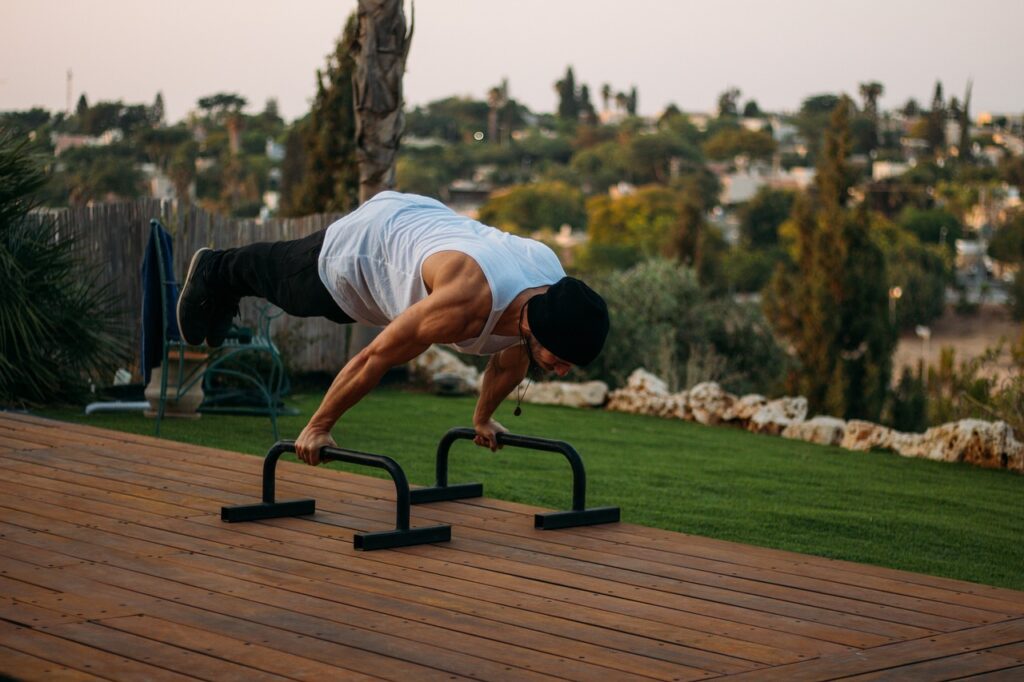
Once you’ve mastered the basics, consider incorporating more advanced movements and techniques to keep challenging your muscles.
Advanced Movements
- Handstand Push-Ups: For advanced shoulder and triceps strength.
- Muscle-Ups: Combining a pull-up and a dip in one seamless movement.
- One-Arm Push-Ups: Intensifies the challenge for your chest, shoulders, and triceps.
High-Intensity Interval Training (HIIT)
HIIT involves short bursts of intense exercise followed by brief rest periods. This method can be applied to bodyweight exercises for cardiovascular benefits and added challenge.
Sample HIIT Circuit:
- Burpees: 30 seconds
- Mountain Climbers: 30 seconds
- Jump Squats: 30 seconds
- Push-Ups: 30 seconds
- Rest: 1 minute
Repeat this circuit 3-4 times for a full workout.
Combining Bodyweight and Cardio
Integrating cardio exercises can enhance the effectiveness of your bodyweight workouts. Activities like running, jumping rope, or cycling can improve cardiovascular endurance and fat loss.
Cardio-Bodyweight Combo Circuit
Create a balanced workout by combining cardio and bodyweight exercises in a single session.
Sample Circuit:
- Jump Rope: 2 minutes
- Push-Ups: 1 minute
- Running in Place: 2 minutes
- Squats: 1 minute
- High Knees: 2 minutes
- Plank: 1 minute
Repeat for 3 rounds, making sure to maintain proper form and intensity.
Progress Tracking and Motivation
Tracking your progress and staying motivated are key components to long-term success with bodyweight workouts.
How to Track Progress
- Log Workouts: Keep a journal or use an app to record exercises, sets, and reps.
- Monthly Assessments: Test your abilities in push-ups, squats, and planks every month.
- Photos and Measurements: Take before-and-after photos and body measurements to visually track changes.
Staying Motivated
- Set Goals: Establish short-term and long-term fitness goals.
- Mix It Up: Vary your workouts to prevent boredom and plateauing.
- Find a Workout Buddy: Exercising with a friend can enhance accountability and motivation.
- Celebrate Milestones: Reward yourself when you reach fitness goals to stay motivated.
Common Mistakes and How to Avoid Them
Even with bodyweight exercises, it’s possible to fall into some common pitfalls that can derail your progress.
Poor Form
Proper form is crucial to avoid injury and ensure the effectiveness of each exercise. Always prioritize quality over quantity.
- Warm-Up: Always warm up your muscles before diving into intense exercises.
- Watch Tutorials: Study correct form through videos or a trainer.
- Mirror Check: Use a mirror to check your form periodically.
Lack of Progression
Without progression, the muscles will not be continually challenged, leading to stagnation.
- Increase Reps: Gradually increase the number of repetitions or sets.
- Try Variations: Switch to more challenging exercise variations as you progress.
- Incorporate Weights: Once comfortable, you can add weights to some exercises for additional resistance.
Skipping Recovery
Recovery is as essential as the workout itself to allow muscles to heal and grow stronger.
- Rest Days: Ensure you have at least one rest day per week.
- Hydrate and Eat Well: Proper nutrition and hydration support recovery.
- Sleep: Aim for 7-9 hours of sleep per night to give your muscles time to recover.
Adapting Workouts for Different Fitness Levels
Bodyweight workouts are adaptable and can be tailored to suit beginners, intermediates, and advanced fitness enthusiasts.
Beginner Level
Start with fundamental exercises and focus on building a consistent routine. Keep the movements simple and avoid overburdening yourself initially.
Sample Beginner Routine:
- Push-Ups (Knee): 3 sets of 8
- Bodyweight Squats: 3 sets of 10
- Plank: 3 sets of 20 seconds
- Assisted Pull-Ups: 2 sets of 5
Intermediate Level
As you become more comfortable with the basic movements, you can increase the challenge by incorporating variations and adding reps.
Sample Intermediate Routine:
- Standard Push-Ups: 3 sets of 15
- Jump Squats: 3 sets of 15
- Side Planks: 3 sets of 30 seconds
- Pull-Ups: 3 sets of 5-8
Advanced Level
For advanced levels, focus on high-intensity and complex movements that challenge multiple muscle groups.
Sample Advanced Routine:
- One-Arm Push-Ups: 3 sets of 5 per arm
- Pistol Squats: 3 sets of 8 per leg
- Handstand Hold: 3 sets of 30 seconds
- Muscle-Ups: 3 sets of 5
Conclusion
Bodyweight workout routines offer a versatile, effective way to build strength without the need for fancy equipment or a gym membership. These exercises can be scaled to match any fitness level, ensuring everyone can benefit from them. By understanding how to perform each exercise correctly and structuring your workouts thoughtfully, you can achieve significant strength gains and enhance your overall fitness.
Remember, consistency and progression are key. Regularly challenge yourself, keep track of your progress, and most importantly, listen to your body. As you grow stronger, you’ll find satisfaction in mastering progressively more challenging moves, all while improving your functional fitness and health. Now, it’s up to you to incorporate these techniques into your regular fitness routine, stay motivated, and enjoy the journey towards a stronger, healthier you.