
Have you ever wondered how to enhance your day-to-day movements, reduce the risk of injury, and feel more agile during your workouts? Improving flexibility and mobility are paramount for overall physical wellness and can bring about numerous benefits. This guide will provide you with workout routines specifically designed to enhance these aspects of your fitness.

Introduction to Flexibility and Mobility
What is Flexibility?
Flexibility refers to the range of motion that your muscles and joints can achieve. It is determined by the length and elasticity of muscles, tendons, and ligaments. If you can touch your toes with ease or do a split, you’re demonstrating good flexibility.
What is Mobility?
Mobility, while related to flexibility, is about your ability to move through a range of motion with control and stability. Unlike flexibility, which is more about how far you can stretch, mobility involves how efficiently you can move. For example, a squat requires good ankle, hip, and thoracic spine mobility.
The Importance of Flexibility and Mobility
Reducing Risk of Injury
One of the main benefits of enhanced flexibility and mobility is injury prevention. When your muscles and joints are well-conditioned, they are less prone to injuries. Increased mobility ensures your joints move correctly, reducing wear and tear.
Improving Performance
Enhanced flexibility and mobility can lead to better performance in sports and everyday activities. For athletes, it means improved technique and endurance. For non-athletes, it means easier completion of everyday tasks like bending down to pick something up.
Enhancing Posture
Maintaining good flexibility and mobility helps in keeping an upright posture. This, in turn, can prevent back pain and other postural issues. A well-maintained posture also enhances breathing efficiency and overall well-being.
Components of a Flexibility and Mobility Routine
Dynamic Stretching
Dynamic stretches involve moving parts of your body and gradually increasing reach, speed of movement, or both. These stretches are useful before starting a workout as they help in warming up the muscles.
Static Stretching
Static stretching involves extending your targeted muscles to the point of tension and holding the stretch for up to 30 seconds. This type of stretching is beneficial post-exercise when your muscles are warm and pliable.
Foam Rolling
Foam rolling helps to release muscle tightness and improve blood flow. It acts by applying pressure to specific points on your muscles. This technique can be used before and after workouts to increase flexibility and mobility.
Mobility Drills
These are specific exercises designed to enhance the range of motion in your joints. Mobility drills are functional and can be included any time during your workout routine to make sure your joints are moving optimally.
Sample Workout Routines
Routine 1: Full-Body Flexibility Routine
A balanced approach that targets all major muscle groups.
| Exercise | Duration/ Reps |
|---|---|
| Forward Lunges | 10 each side |
| Side Lunges | 10 each side |
| Quad Stretches | 30 seconds each |
| Hamstring Stretch | 30 seconds each |
| Calf Stretch | 30 seconds each |
| Torso Twist | 15 reps each side |
| Shoulder Stretch | 30 seconds each side |
Forward Lunges
- Stand tall with your feet together.
- Step forward with one foot and lower your hips until both knees are bent at about a 90-degree angle.
- Return to the starting position.
- Repeat for the other side.
Side Lunges
- Stand tall with your feet shoulder-width apart.
- Step to one side and lower your hips, bending your knee and keeping the opposite leg straight.
- Return to the starting position and switch sides.
Routine 2: Upper Body Mobility Routine
Focuses on enhancing mobility in your shoulders, neck, and upper back.
| Exercise | Duration / Reps |
|---|---|
| Arm Circles | 30 seconds each way |
| Neck Rotations | 10 each direction |
| Cat-Cow Stretch | 10 reps |
| Thoracic Rotations | 10 reps each side |
| Shoulder Dislocations (using a stick) | 10 reps |
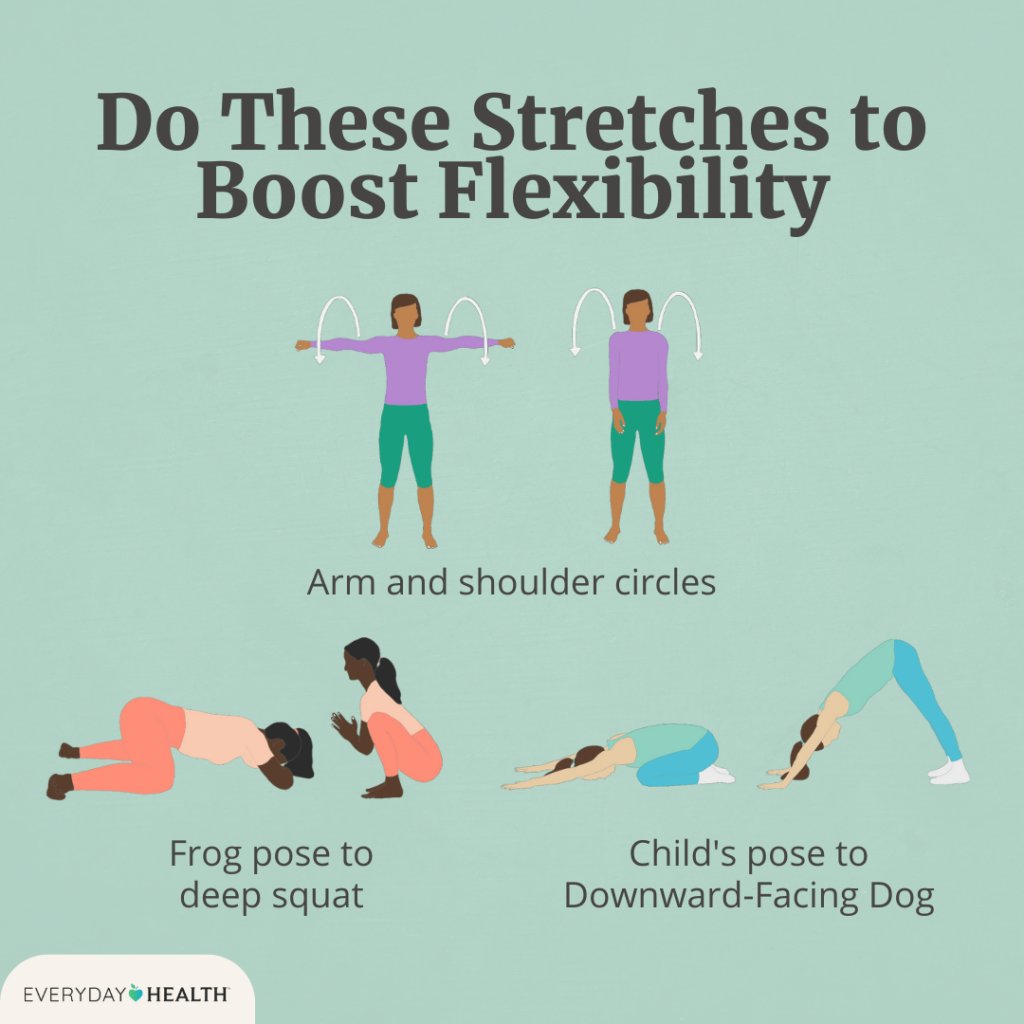
Arm Circles
- Extend your arms out to the sides.
- Make small circles, gradually increasing the size.
- Reverse the direction of the circles after 30 seconds.
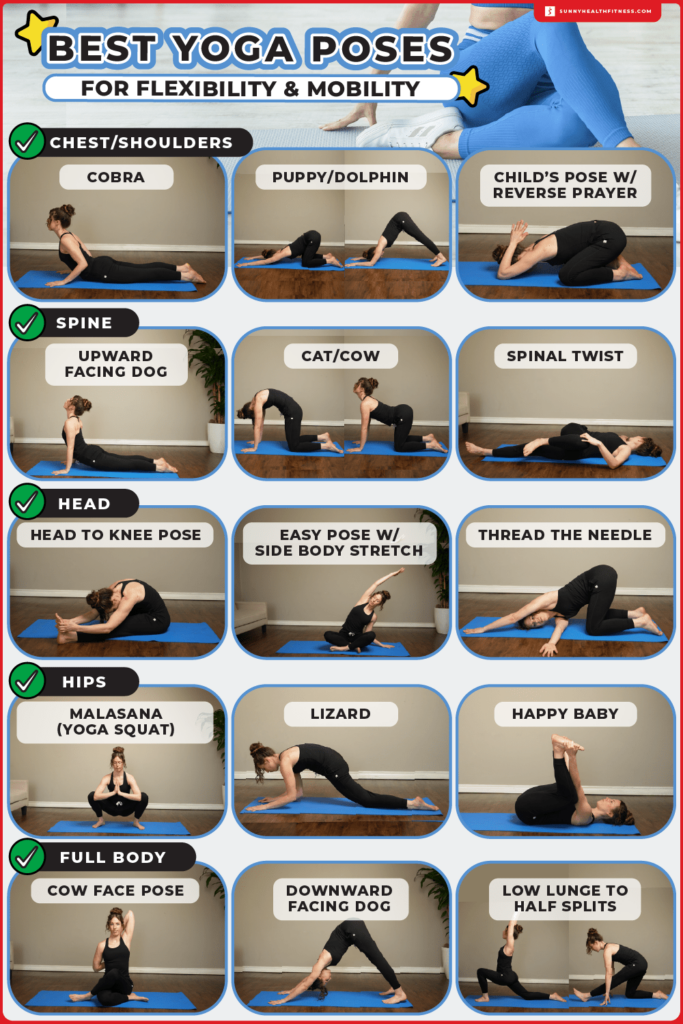
Cat-Cow Stretch
- Start on all fours with hands directly under your shoulders.
- Inhale as you drop your belly towards the floor and lift your gaze (Cow pose).
- Exhale as you round your back towards the ceiling, tucking your chin (Cat pose).
Routine 3: Lower Body Mobility Routine
Enhances the range of motion in your hips, knees, and ankles.
| Exercise | Duration / Reps |
|---|---|
| Hip Circles | 10 each direction |
| Knee Tucks | 10 each side |
| Ankle Circles | 10 each direction |
| Pigeon Stretch | 30 seconds each side |
| Deep Squats | 10 reps |
Hip Circles
- Stand on one leg, using a wall for support if necessary.
- Move your raised leg in a circular motion, 10 times clock-wise and 10 times counter-clockwise.
- Repeat with the other leg.
Pigeon Stretch
- Start in a plank position.
- Bring your right knee forward and place it behind your right wrist, with your ankle near your left hip.
- Straighten your left leg behind you, toes tucked under.
- Hold for 30 seconds and switch sides.
Routine 4: Foam Rolling Session
Foam rolling is beneficial for releasing muscle tension and enhancing flexibility.
| Exercise | Duration |
|---|---|
| Upper Back Roll | 1 minute |
| IT Band Roll | 1 minute each side |
| Quadriceps Roll | 1 minute each side |
| Hamstrings Roll | 1 minute each side |
| Calves Roll | 1 minute each side |
Upper Back Roll
- Sit on the floor with the foam roller placed at your mid-back.
- Lean back and roll upwards, towards your upper back.
- Roll back and forth for one minute.
Routine 5: Mixed Flexibility and Mobility Routine
A combo workout for overall flexibility and mobility.
| Exercise | Duration/ Reps |
|---|---|
| Dynamic Hip Flexor Stretch | 10 each side |
| Downward Dog to Upward Dog Transition | 10 reps |
| Spider-Man Stretch | 10 each side |
| World’s Greatest Stretch | 5 each side |
| Child’s Pose with Reach | 30 seconds each side |
Spider-Man Stretch
- Start in a push-up position.
- Bring your right foot to the outside of your right hand.
- Drop your hips and hold for a few seconds, then return to push-up position.
- Switch sides.
Downward Dog to Upward Dog Transition
- Begin in a downward-facing dog position.
- Lower your hips and transition to upward dog by pushing through your arms and lifting your chest towards the ceiling.
- Return to downward dog and repeat.
Tips for Maximizing Flexibility and Mobility Gains
Consistency is Key
As with all fitness goals, consistency is crucial. Make it a habit to incorporate flexibility and mobility exercises into your routine at least 3-4 times a week.
Listen to Your Body
It’s essential to distinguish between discomfort and pain. Stretching can be uncomfortable at times, especially if you’re new to it, but it shouldn’t be painful. If you feel sharp pain, stop immediately and reassess your technique.
Combine with Strength Training
Enhancing strength will support your flexibility and mobility efforts. Strong muscles contribute to better stabilization and control within your range of motion, allowing you to stretch further and move better.
Warm-Up Properly
Always warm up before engaging in any stretching or mobility work. Warm muscles are more pliable and less prone to injury. Dynamic stretching is a great way to warm up before a workout.
Stay Hydrated
Hydration plays a vital role in maintaining tissue elasticity. Drink plenty of water throughout the day to support your flexibility and mobility.
Common Myths About Flexibility and Mobility
Myth: Flexibility is Only for Dancers and Gymnasts
Flexibility and mobility are important for everyone, regardless of your activity level. They play a critical role in preventing injury and ensuring overall body functionality.
Myth: You Need to Be Young to Be Flexible
While it’s true that children are generally more flexible, adults can greatly improve their flexibility and mobility with consistent practice. Age is not a barrier; it just might take more time and dedication.
Myth: Stretching Before a Workout Prevents Injury
Static stretching before intense physical activity can actually weaken performance and increase the risk of injury. Instead, engage in dynamic stretches to warm up your muscles and prepare them for the demands of the workout.

Conclusion
Improving your flexibility and mobility is a rewarding endeavor that can enhance your performance, reduce the risk of injury, and improve overall quality of life. Incorporate the workout routines provided in this guide into your fitness regimen, and you’ll likely begin to notice a difference in how your body feels and moves. Keep consistent, listen to your body, and enjoy the journey to a more flexible and mobile you!